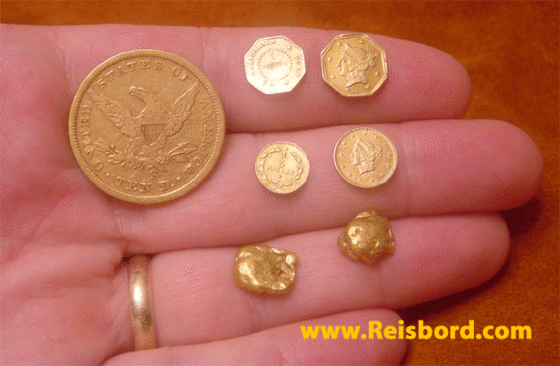
The gold rush economy of Northern California in the early 1850's lacked sufficient smaller denomination coins to facilitate the rapidly growing commerce of the area.Federal coinage was hoarded and not readily available. Because of the abundance of native gold and lack of small denomination coins, transactions were often made with gold dust, nuggets, and other primitive assay products, like the amalgam ball.
By 1852 several entrepreneurs began making small gold coins of varying values. Mostly jewelers by trade, these men frequently hand struck these little coins. The practice of making private small gold coins continued for years after the San Francisco mint was producing sufficient coinage for the West, with most later pieces produced as souvenirs.
Today California fractional gold coins are often categorized into two classes based on when they were struck. Period 1 coins were minted from 1852 to 1856. Many experts in the field agree that these pieces were often used as small change in the gold rush, and this theory is supported by the fact that a significant percentage of these early pieces have circulation wear. By contrast, period 2 coins were made from 1859 to 1882, and are often called "jewelers issues." These pieces frequently have much less gold content than their stated value would dictate. Additionally, these later pieces are more often found in high states of preservation, as they were usually saved as souvenirs from the California gold fields.
Fractional gold coins come in denominations of 25 cents, 50 cents and one dollar. Additionally, coins come round or octagonal. Collecting these coins can be done by design, denomination, or by variety. However, there are over 500 different varieties in the series, with many pieces being prohibitively rare and thus make infrequent appearances at auction. The varieties are most often noted by a BG number, in reference in a book co-authored by Breen and Gillio.